

Each child will thrive in their discovery of self-knowledge, nature and ingenuity, applying their creativity and imagination as architects of a more resilient, collaborative and interconnected future.
Located on a Spanish finca just outside Sotogrande, we have the good fortune to enjoy expansive views across to Gibraltar and Morocco, fields to play on, trees to climb and animals to care for. We also make good use of the surrounding natural parks and beaches to immerse our learning in the natural environment.
With 28 nationalities represented in our student body and 80% of our families having relocated to join the school, we are proud to be a truly international community. We prioritise discovery over traditional teaching, embracing a curriculum that transcends boundaries and disciplines. This approach empowers our students to follow their passions and marvel at all the world has to offer. Co-creating journeys of discovery with our students lies at the heart of what we do.
Internationally accredited and staffed by experienced educators, we ensure our students have ample opportunities to develop academically while embarking on these journeys of discovery. Our curriculum is intellectually challenging and conceptual learning happens at an advanced level. Your six-year-old might just come home and want to discuss the relativity of time and the emergence of perspective in Renaissance art. Small class sizes and an intentionally small school enable us to support each student individually, allowing them to work at a pace suited to their maturity and developmental needs.
As a community of learners, we value an open and honest exchange of ideas and build relationships based on a shared humanity, with all its flaws, rather than identities centred on being a teacher or student. As a tribe, we make Alma Forest a home where we can all come to know ourselves better and develop a lifelong love of learning and discovery.
This model of education feels and looks different. It is best understood by visiting our school, talking to our teachers and students, and taking in the space and atmosphere. It is a place where students and teachers come alive.
“If you want to build a ship, don’t drum up the people to gather wood, divide the work and give orders. Instead, teach them to yearn for the vast and endless sea.”



“Maturity — that means, to have reacquired the seriousness that one had as a child at play.”
“Learning to read and write makes little sense if you don't understand what you're reading and writing about. While we may have forgotten, most of our early learning came not from being explicitly taught but from experiencing.”

At Alma, our foremost priority is nurturing intrinsic motivation. When a child's innate curiosity is kindled, it paves the way for meaningful learning and a lifelong passion for education.
Understanding that every child is unique, we recognise that each one follows their own individual learning journey. Our responsive curriculum allows students to advance at their own pace, giving them the time and space to find their own way into academic learning. Whether a child is already excelling or needs longer to develop specific skills, our framework accommodates these varied needs.

This process cannot be rushed, and it flourishes best within a climate of patience and encouragement. Here the trust of teachers and parents alike becomes essential: when the adults around a child have faith in their unfolding journey, the child is free to grow in confidence. In this way, Alma Forest offers a balanced, real-world educational experience that supports every child and holds no one back.
“Creativity is not an option, it’s an absolute necessity.”
“The truly creative changes and the big shifts occur right at the edge of chaos.”

The edge of chaos is the exhilarating, liminal space we strive to live in. We give students the freedom to express themselves and contribute as co-creators alongside our teaching team. Each year brings its own character, shaped by student input and the Explorations and Projects we choose to pursue, while building on a curriculum that ensures the acquisition of key skills.
This is not disorder for its own sake. Genuine learning, like genuine creativity, tends to happen at the boundary, in the narrow, dynamic space between too much structure and too little. Too much order and learning becomes rote, predictable, closed to discovery; too much chaos and nothing coheres long enough to foster deep understanding. We aim for the space in between: enough scaffolding that students can take real risks safely, and enough openness that those risks lead somewhere genuinely their own.

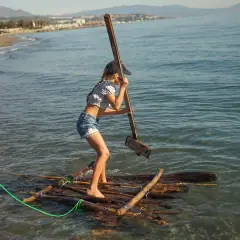
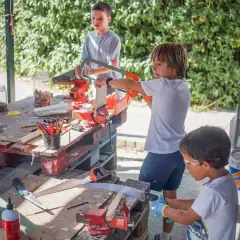
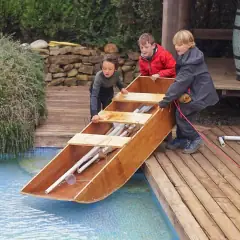
In practice, this means learning is real, not simulated. Students build, test, and revise things that are relevant and matter to them, encountering the same false starts, failures, and breakthroughs that any maker or scientist encounters outside a school. The unpredictability of this process isn't a bug to be engineered out; it's the condition under which the most durable learning tends to occur. A curriculum that never changes stops asking anything new of the people inside it. A curriculum that changes too fast never lets anyone build mastery. We try to sit deliberately at that edge.
“Everything you do is education.”
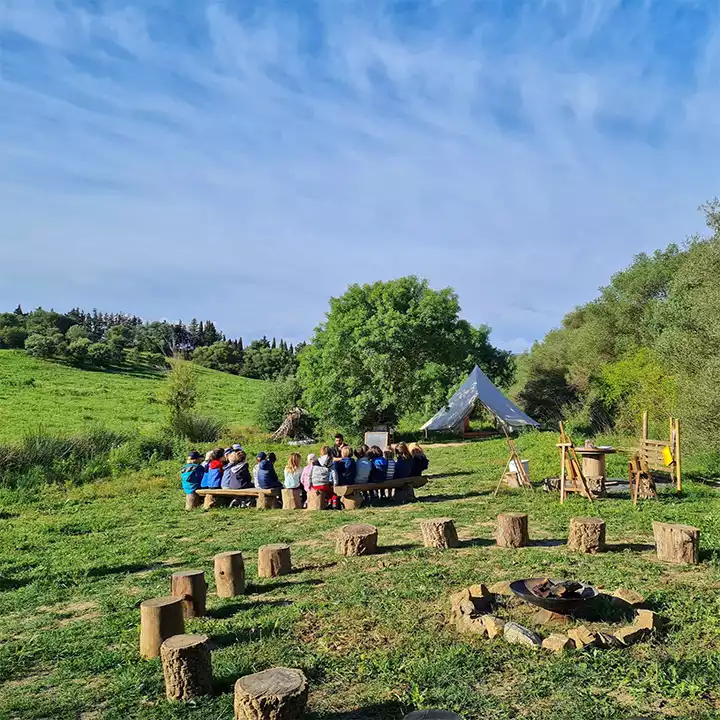
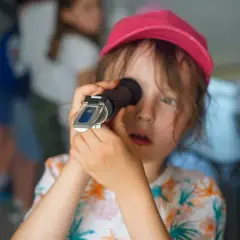
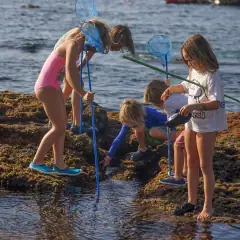
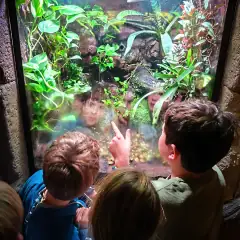
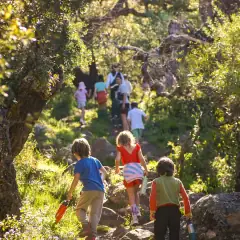
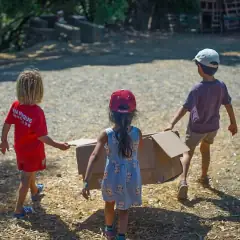
Our preschool is rooted in the Forest School tradition. Children spend their day outside, learning in and from nature. Experienced forest school educators guide children to expand their horizons and support their developmental needs. Children can access a variety of activities throughout the day, some teacher-led and many based on independent exploration. Fostering intrinsic motivation to engage and learn is central to Escuela Bosque. Students take their learning across the farm and forest, engaging their interests deeply, with learning initiated equally by the student, teacher and environment.
Read the Escuela Bosque Curriculum Outline (PDF opens in a new tab)
PDF opens in a new tab.
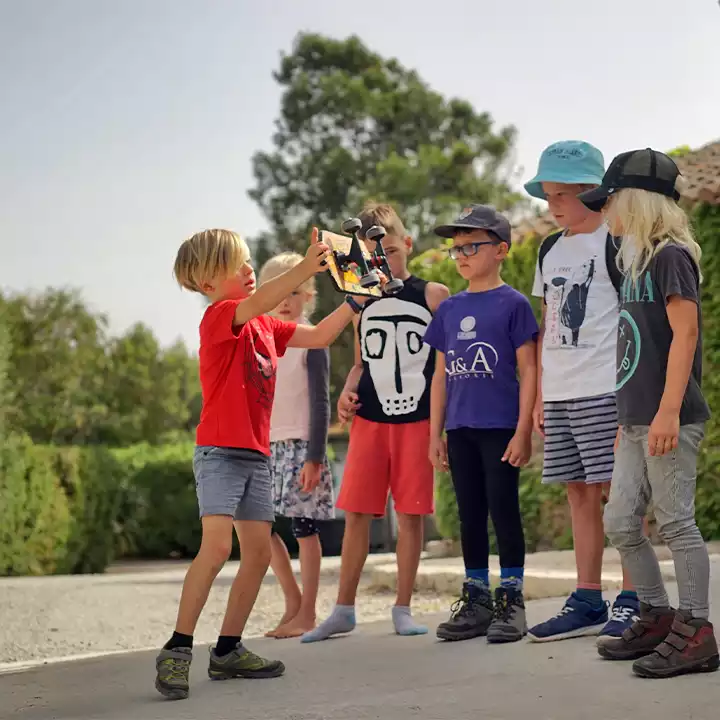
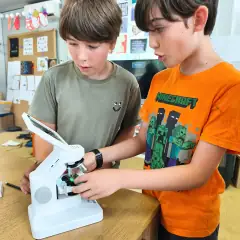
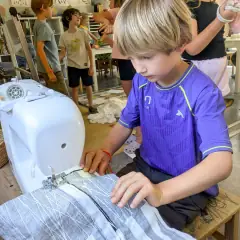
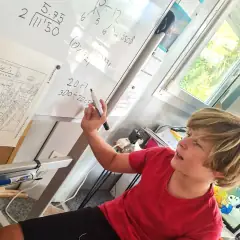
In Primary School, children build on skills acquired in Escuela Bosque. Academic workshops are based on international standards, using resources developed by and used in international schools around the world. We incorporate these workshops into transdisciplinary projects co-created with students and guided by their interests. Pupils spend approximately 25% of their time working on self-directed projects that they choose, plan and complete with support from peers and teachers. The natural environment underpins all of this as inspiration, teacher and classroom.
Read the Primary Curriculum Outline (PDF opens in a new tab)
PDF opens in a new tab.

In Middle School, our students thrive in their discovery of conceptual knowledge. As they move through Escuela Bosque and Primary School, students acquire a strong sense of self and the ability to take responsibility for learning. They use these skills to conduct independent research and create complex projects of their own design. We encourage students to engage with the environment through projects and to think about affecting change beyond the school community. Students continue to hone academic skills through tutorials and group workshops.
Read the Middle School Curriculum Outline (PDF opens in a new tab)
PDF opens in a new tab.
“Much important learning cannot be measured or counted.”
“Education is an act of love, and thus an act of courage.”
A small team with 150+ years of teaching experience.
Students transitioning from traditional schools typically adapt well to our environment, though they may require some time to acclimate to the increased freedom and responsibility. Thanks to our intimate class sizes, students have the room to adjust, supported by both our dedicated teachers and senior students.
Academically, our students achieve at par with their counterparts in other international schools. Our teaching materials are sourced from curricula used by leading international schools globally. Those who journey through Alma Forest leave equipped with skills that empower them to excel as independent learners in any setting.
In Escuela Bosque, each day begins with a story, mindfulness and culture-building exercises. Thereafter, the children are introduced to the weekly nature-based theme. Following the morning circle time, children can explore independently or engage with teacher-led activities that enable them to experience the theme more deeply.
Our Primary School students also begin the day with a morning circle focused on empathy, relationship building and the exchange of ideas. Days in school usually include academic workshops, class projects and personal projects. Depending on the class project, we might spend days at the beach or in the forest, and often adjust plans to incorporate events on the farm or a spontaneous exploration.
In Escuela Bosque, days run Monday to Friday, 9am to 2:30pm. We also run an after-school club until 5pm, separately invoiced.
In the Primary School, the day starts at 8:50am and ends at 3:30pm, Monday to Thursday. On Fridays, we finish at 3pm.
In Escuela Bosque, the teacher-to-student ratio is 1:8.
In the Primary School, this varies by age group. Our younger groups are supported by a teacher and a teaching assistant, while older children have a class teacher. Class sizes do not exceed 15 learners.
We believe that our model of education is best suited to long-term enrolment. Children need time to get used to freedom and responsibility in order to gain the most from what we offer.
There is no English-language requirement. As an international school, we support children who are learning English as an additional language.
We follow the old Scandinavian saying, ‘There is no bad weather, only bad clothing.’ If it is raining, students come dressed appropriately, with weatherproof clothing and a spare set of warm clothes. Different conditions let students explore how the environment changes through the seasons.
Escuela Bosque students are outside every day apart from weather deemed extreme in our risk assessment, such as high winds, hard rain, lightning and thunder. In these cases, we have indoor facilities. Primary students have permanent classroom spaces and spend more time there during inclement weather.
Parents can opt into the catering option at an additional cost, or students can bring a packed lunch to school.
All children bring a morning snack and water. We encourage healthy snacks and recommend avoiding sugar or processed foods for snacks and lunches.
We ensure that technology enhances learning. Digital technology is introduced in Primary School to help learners record progress in a digital portfolio and conduct research. Students learn digital literacy and use technology to create art and communicate ideas. Middle School students create portfolio websites, engage with programming and develop 3D design skills.